Holiday Peacemaking 101

handling-holiday-conflict-arti

With the holidays each year comes increased opportunity for conflict in relationships. Unrealized expectations, margin-less schedules, extended family demands, and a host of other stress-escalating factors conspire to heighten the potential for relational strife. In the spirit of Rom. 12:18, “so far as it depends upon you be at peace,” consider these principles for making it to 2014 without suffering a conflict train wreck.

First, check your expectations at the front door of the season. Idealistic notions of the holidays with their feel-good promises often fall short of the realities of dealing with family and friends whose total depravity doesn’t automatically take a break from Thanksgiving to New Years.  Remember that everyone you engage could legitimately compete with Paul in 1 Tim. 1:15 for the title “chief of sinners.” While you’re at it, assume that you qualify for the label over and above anyone else at the party and you will go a long way toward enjoying the blessedness of a peacemaker this Christmas (Matt. 5:9).

Second, overlook offenses. A lot. Assume folks will do and say some things during what the recovery movement calls “the silly silly seasonseason” just because so much of the craziness is just that. Exercise more patience than usually required. Proverbs 19:11 counsels, “Good sense makes one slow to anger and it is his glory to overlook an offense.” Overlooking can get overlooked as among the virtues qualifying as glorious. One reason the overlook strategy makes good sense comes into perspective in another wisdom saying in Prov. 17:14. “The beginning of strife is like letting out water, so quit before the quarrel breaks out.” Count the cost doesn’t just apply to financial decisions but relational ones as well. It may not pay to start the battle in the first place, so let it go whenever in good conscience you possibly can.

Third, when you can’t overlook for the gravity of an offense, go straight to the person involved – do not talk to someone else about it – and seek to resolve the matter between you and him in private (Matt. 18:15). Treat the person the same way you would want to be treated if the shoe were on the other foot. Let texts like Gal. 6:1-2 dictate your timing, approach, and most of all objective – bearing a fellow-sinner’s burden by helping rescue them from the trespass you believe has ensnared them.

Fourth, overcome evil with good through not returning the same. Rather, determine to heap coals of love on a head when you get the chance (Rom. 12:17-21). The holidays typically bring us into close quarter contact with folks, including relatives, with whom we might otherwise prefer not to associate. Make conversation. Ask questions. Serve quietly. Don’t just look out for your own interests but even those of your obnoxious cousin (Phil. 2:3-4).

Fifth, and most importantly, take your cue from the One the Bible calls the Prince of Peace (Isa. 9:6-7), drawing strength from Him and the power of His gospel, in your determination to live at peace with others throughout the holiday season. In her article, “Walking in Peace Amid Holiday Strife,” Tara Barthel writes:

If we are to walk as people of peace during the stress of the holidays, we must first begin by remembering the greatness of God and all that he has done for us in Christ. Then we can move on to how we are to live in light of these truths. If we try to skip the first step and move to the changing of our behavior, we will probably end up frustrated both by our own failures as well as the fallenness of those around us. Our only hope is in God—he justifies us, redeems us, delivers us from our shame, and conforms us to Christ (Romans 8:29). Such a God! Such a Savior! This is the Jesus whose birth we celebrate during this Christmas holiday season.

What she said.

May the Prince of Peace fill you with the spirit of peace for the making of real peace in the face of your holiday conflict, if and when you eventually tangle with it.

A Holiday Reflection

Thanksgiving-Image

I woke up early this morning with First Thessalonians 5:16-18 on my mind. “Rejoice always, pray without ceasing, give thanks in all circumstances; for this is the will of God in Christ Jesus for you.” I got up and did some digging in the text. Here are some thoughts that may help shape this holiday in a Godward fashion. Bottom line?  Simple. Be joyful, be prayerful, and be thankful.

These staccato exhortations by the apostle come embedded in a series of final instructions to the church at Thessalonica.  Everything therein focuses on obligations for the church in community as a whole. Even the three verbs in v. 16-18 all have second person plural “we” subjects. So while I don’t think it wrong to apply commands (imperatives all) like rejoice, pray, and give thanks to the individual, personal life of the believer, Paul stresses in the text the necessity of the church gathered putting on these gospel graces. He’s adamant about this. It is the will of God for those of us who are connected to Christ Jesus by grace through faith. Corporate worship should consistently look like a joyful, prayerful, thankful affair. Do I hear an “Amen!” from the Hebrew poet (Psalm 95:1-2)? Absolutely.

The emphasis Paul puts on the need for consistency in these practices stands out big time in the Greek text. The present tense of the verbs conveys continuous, keep-on-doing-these-things, kind of action. As if that were not enough, Paul uses adverbs like “always” and “unceasingly” and the prepositional phrase “in all things.” And he places all three modifiers before each verb to punctuate the emphasis. ALWAYS rejoice, WITHOUT CEASING pray, IN EVERYTHING give thanks.  He virtually dares us to miss the point. A gospel-shaped people gathered to worship King Jesus for who He is and all He has done should relentlessly manifest a joyful, prayerful, and thankful DNA from start to finish.

What embracing each of these graces looks like will have to wait for later posts. But one final consideration. The three intersect and overlap. Charles Spurgeon said it well:

When joy and prayer are married their first born child is gratitude. When we joy in God for what we have, and believingly Spurgeonpray to him for more, then our souls thank him both in the enjoyment of what we have, and in the prospect of what is yet to come. Those three texts are three companion pictures, representing the life of a true Christian, the central sketch is the connecting link between those on either side. These three precepts are an ornament of grace to every believer’s neck, wear them every one of you, for glory and for beauty; “Rejoice evermore;” “Pray without ceasing;” “in everything give thanks.”

When you get dressed today for your Thanksgiving celebration with whomever and wherever, make sure you put on your ornaments of grace. Wear them for glory and for beauty. And please don’t forget to do the same when Sunday rolls around and you head off to church for your Lord’s Day worship.

To Retreat or Not To Retreat?

MensRetreat

That is indeed the question for this weekend. Another men’s retreat is upon us. The answer to the question for me is a no brainer. Retreat, of course. And not just because my role as pastor requires it. I would like to think I would make our men’s retreat a priority for a variety of reasons.

However, one stands out to me more than others. Proverbs 27:17 – Iron sharpens iron, and one man sharpens another. Why invest twenty-four hours with a bunch of brothers from my church? Because isolation makes PC a dull blade. Before I skin a deer in Idaho, I sharpen my knife with a whetstone. Why? The tool works a whole lot better in an otherwise tedious process. The Bible says brothers hanging with brothers doing gospel life and talking gospel things makes men sharp for life. I’m dull enough without skipping a main means God employs for my sharpening.

Charles Bridges, in his classic commentary on the book of Proverbs explains:

ironsharpensiron“Man was framed not for solitude, but for society (Gen. 2:18). It is only as a social being, that his powers and affections are fully expanded. . . . Steel, whetted against a knife, sharpens the edge. So the collision of different minds whets each the edge of the other. . . . In the sympathies of friendship, when the mind is dull, and the countenance overcast, a word from a friend puts an edge upon the blunted energy, and exhilarates the countenance. . . . Gladly let us take up the bond of brotherhood.”

To retreat or not to retreat? How do you answer the question? Say yes this weekend and gladly take up the bond of brotherhood.

Why Pray for the Persecuted Church?

IDOP-2013-international-day-of-prayer-for-the-persecuted-church

Tomorrow brings us to another International Day of Prayer for the Persecuted Church. We will devote exclusively our monthly concert of prayer on the evening of the 10th at 6 PM in F5 to interceding for our brothers and sisters in chains. Why does it matter that we do this? Here are several reasons.

  1. Jesus suffered much at the hand of a host of persecutors. He identifies completely with their weakness (Heb. 4:15). So should we.
  2. Multitudes of believers worldwide, some 200 million, pay a great price for their faith, even martyrdom. The sheer extent of the need cries for our attention. More Christians were martyred in the 20th century than in all previous centuries combined (International Journal of Missionary Research). 
  3. Scriptures command us to remember their plight as if incarcerated with them (Heb. 13:3). How better to remember than in prayer?
  4. The most frequent prayer request by the persecuted is that other believers would pray for and with them. Can we possibly refuse?
  5. When one member of the body suffers, all suffer (1 Cor. 12:26).  Sixty to ninety minutes of prayer is a small price to pay to identify with the suffering of dear saints around the globe.
  6. Praying for one another imitates the model of Jesus who prayed for Peter in advance for his strength in the face of persecution sure to come (Luke 22:32). What would Jesus do?
  7. God answers prayers for the persecuted in miraculous ways.

One reason why I read Voice of the Martyrs’ monthly newsletter is that it includes countless reports of how God miraculously encourages saints under duress as a direct result of the prayers of God’s people on the other side of the world. Join us on Sunday evening.

Part of me wants to say this: if you don’t come to any other of the eleven concerts of prayer OGC hosts, come to this one. Remember the persecuted. In the sovereignty of God you and I could just as easily find ourselves today holed away in a North Korean prison camp for our faith as opposed to luxuriating ourselves in the affluent West. Enough said.

For a look at the World Watch list top 50 restricted nations for 2013 click here.

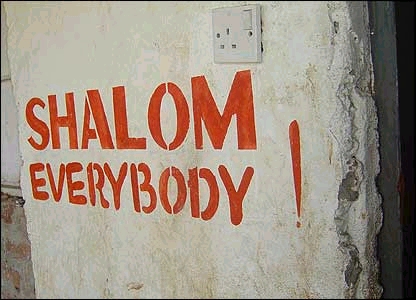
Shalom-Seeking on Steroids

shalom_everybody

Last Sunday for OGC’s 22nd anniversary I preached a message on Jeremiah 29:1-14 called Our City, Our Mission. You can listen to the audio here.

In verse seven of that passage the prophet tells the exiles from Judah living in Babylon to seek the welfare of the city to which Yahweh has sent them. The word for welfare is the Hebrew word shalom. It often gets translated by the English word peace. The word flourishing captures well the comprehensive nature of the term.

In his book, Generous Justice: How God’s Grace Makes Us Just, Tim Keller shares an example of a radical form of shalom-seeking that illustrates a serious commitment to this ethic within a community. It’s a bit long but worth the read.

An intriguing real life example of an entire community doing justice and seeking shalom is laid out in Yale professor Nora Ellen Croce’s book Everyone Here Spoke Sign Language.  In the 1980’s Croce was researching hereditary deafness on Martha’s Vineyard.  In the seventeenth century the original European settlers were all from a region in Kent, England, called “the Weald” where there was a high incidence of hereditary deafness.  Because of their geographical isolation and intermarriage the percentage of deaf people increased across the whole island.  By the nineteenth century one out of twenty-five people in the town of Chilmark was deaf and in another small settlement almost a quarter of the people could not hear. (Today, because of the mobility of the population and marriage with off-islanders, hereditary deafness has vanished.  The last deaf person born on the Vineyard died in 1952.)

In most societies, physically handicapped people are forced to adapt to the life patterns of the nonhandicapped, but that is not what happened on the Vineyard.  One day Croce was interviewing an older island resident and she asked him what the hearing people thought of the deaf people.  “We didn’t think anything about them, they were just like everyone else,” he replied.  Croce responded that it must have been necessary for everyone to write things down on paper in order to communicate with them.  The man responded in surprise, “No, you see everyone here spoke sign language.”  The interviewer asked if he meant the deaf people’s families.  No, he answered, “Everybody in town–I used to speak it, my mother did, everybody.”  Another interviewee said, “Those people weren’t handicapped.  They were just deaf.”  One other remembered, “They [the deaf] were like anybody else.  I wouldn’t be overly kind because they, they’d be sensitive to that.  I’d just treat them the way I treated anybody.”
Generous JusticeIndeed, what had happened was that an entire community had disadvantaged itself en masse for the sake of a minority. Instead of making the nonhearing minority learn to read lips, the whole hearing majority learned signing.  All the hearing became bilingual, so deaf people were able to enter into full social participation.  As a result of “doing justice” (disadvantaging themselves) the majority “experienced shalom”–it included people in the social fabric who in other places would have fallen through it.  “When they had socials or anything up in Chilmark, why, everybody would go and they [the deaf] enjoyed it, just as much as anybody did.  They used to have fun–we all did….They were part of the crowd, they were accepted.  They were fishermen and farmers and everything else….Sometimes, if there were more deaf people than hearing there, everyone would speak sign language–just to be polite, you know.”  Deafness as a “handicap” largely disappeared.
Perhaps the most interesting aspect of Croce’s research was the revelation of how hearing people had their own communication abilities enhanced.  They found many uses for signing besides communication with the deaf.  Children signed to one another during sermons in church or behind a teacher’s back at school.  Neighbors could sign to one another over distances in a field or even through a spyglass telescope.  One woman remembers how her father would be able to stand on a windy cliff and sign his intentions to fishermen below.  Another remembers how sick people who could not speak were able to sign to make their needs known.
In other words, the “disadvantage” that the hearing Vineyarders assumed–the effort and trouble to learn another language–turned out to be for their benefit after all.  Their new abilities made life easier and more productive.  They changed their culture in order to include an otherwise disadvantaged minority but in the process made themselves and their society richer.
Martha’s Vineyard was a unique situation.  However, in every time and culture, the principle holds.  The strong must disadvantage themselves for the weak, the majority for the minority, or the community frays and the fabric breaks.
This sounds a great deal to me like 2 Corinthians 8:9. For you know the grace of our Lord Jesus Christ, that though he was rich, yet for your sake he became poor, so that you by his poverty might become rich. The Mega-strong disadvantaged Himself in the ultimate way for the mega-weak that we might become mega-rich in spiritual blessings. I know of no other motivation that will suffice for seeking the welfare of one’s city whether on steroids or any other degree of disadvantaging.