Surviving Sorrow

I Married Up

How’s Nancy?

How are you?

I get these two questions a lot these days. I’m grateful. Caring by others adds greatly to comfort in trial and the soul sorrow it can bring.

As for question one . . .

My wife amazes me. Her devotion to a natural cancer-beating protocol nearly defies description. She has embraced this season’s demanded vocation – getting well – with whatever-it-takes zeal. By way of update, she continues to recover nicely from surgery. Last week the surgeon gave her a good report. Just a couple more weeks to go and she will be back to lifting those boxes of supplements all by herself again. Good thing. My back hurts.

Another blood test revealed slightly elevated CA-125 markers. The doc said “No surprise. Common after surgery.” Now we have a baseline for measuring effectiveness of the treatment regimen. We expect her to check these about monthly from this point on. That way we will have some idea of whether we are gaining, losing, or holding ground in the war against, as I prefer to call it, “this stupid disease.” As always, we would ask for prayer for God’s healing power to rid her body of every renegade cell.

As for question two . . .

How much time do you have? I fight daily on a number of fronts. Among them, sadness. Though January, gratefully, came and went, the sting of Josh’s death lingers. I don’t expect it ever to go away, though the burden does lessen with time. But fear of greater loss can compound my weight of sorrow. I feel it every day.

And yet, every day, it seems the Lord brings something to help me fight better to outlast my sorrow. This morning was no exception, as my daily Bible reading brought me to Matthew 26:36-46 (ESV).

Then Jesus went with them to a place called Gethsemane, and he said to his disciples, “Sit here, while I go over there and pray.” And taking with him Peter and the two sons of Zebedee, he began to be sorrowful
and troubled. Then he said to them, “My soul is very sorrowful, even to death; remain here, and watch with me.” And going a little farther he fell on his face and prayed, saying, “My Father, if it be possible, let this Gethsemanecup pass from me; nevertheless, not as I will, but as you will.” And he came to the disciples and found them sleeping. And he said to Peter, “So, could you not watch with me one hour? Watch and pray that you may not enter into temptation. The spirit indeed is willing, but the flesh is weak.” Again, for the second time, he went away and prayed, “My Father, if this cannot pass unless I drink it, your will be done.” And again he came and found them sleeping, for their eyes were heavy. So, leaving them again, he went away and prayed for the third time, saying the same words again. Then he came to the disciples and said to them, “Sleep and take your rest later on. See, the hour is at hand, and the Son of Man is betrayed into the hands of sinners. Rise, let us be going; see, my betrayer is at hand.”

Not just “sorrowful” but “troubled.” “Even to death.” The cross loomed on the horizon. The tempter lurked in a different garden hunting the Last Adam as he did the first (Genesis 3:1-7). More than ample reason for extreme distress.

How then does Jesus fight? What cues can we take from Him for surviving sorrow, whatever form it takes in our gardens of suffering? Four things: surrounding, seeking, serving, submitting.

One, surrounding ourselves with support. Jesus did not head for that garden alone. He took the disciples with him. The closest of the close he staged a stone’s throw away. He needed them. “Watch WITH me,” was His plea.

Two, seeking God’s help. Falling on His face He prayed. Let those words sink in. Some things only God can fix. Some hurts only the Lord can manage. Some pains only the Father can ease. Some challenges only I AM can handle. The two most important words out of our mouths when struggling to survive sorrow are “My Father,” because they mean we’ve turned heavenward, the only hope of avoiding collapse. And we must persist in this pattern. Three times Jesus went before the Father to voice His prayer. As long as the sorrow hangs around, take it to the Lord in prayer.

Three, serving others in love. The disciples favored a strategy often turned to in sorrow. Sleep. Jesus does not berate them. Even though subject to the temptation of temptations Himself, His best friends no comforters at all, He does not lash out. Rather He teaches and warns. Watch and pray that you may not enter into temptation. The spirit indeed is willing, but the flesh is weak. First the example, next the instruction. You’ve got to watch and pray to survive your sorrows. I’m grateful for the stewardship of pastoral ministry. The call to serve others helps pull me out of sorrow’s tractor beam grip that so often leads to self-pity and despair.

Fourth, submitting to God’s will. If the two most important words out of the gate in sorrow are “My Father,” then the four most strategic words at the finish line are “Your will be done.” Who prays this way? Only those who believe Psalm 115:3. Our God is in the heavens; he does all that he pleases. The Son of God treasured the Father’s sovereignty in all things. He submitted Himself perfectly to His will. He delighted to do that will, even to the point of death, death on a cross (Phil. 2:6-8).

So when I don’t fare so well on any given day in my fight to survive my sorrow, or perhaps my comforters fall asleep on me, I try to remember the One who fought His sorrows and won for me what I cannot do for myself. I commend the same strategy to you as you go through your valley of the shadow whenever and wherever it may come.

Divine Mathematics

math

I hated math. I remember getting a “D” in Mr. Donnelly’s seventh grade class when the “New Math” came out – whatever that was. My overachiever, get-all-A’s world crumbled then and there. It never recovered. In college I did everything I could to stay away from anything mathematics related. Wasn’t I surprised when I signed up for Astronomy 101 that it was a math class in disguise. I just wanted to know about the stars. Took every extra-help Saturday class to survive that one.

Now, divine mathematics is an altogether different thing. That’s what D. A. Carson calls the equation formulated by the Apostle Paul in 1 Corinthians 13: 1-3.

If I speak in the tongues of men and of angels, but have not love, I am a noisy gong or a clanging cymbal. And if I have prophetic powers, and understand all mysteries and all knowledge, and if I have all faith, so as to remove mountains, but have not love, I am nothing. If I give away all I have, and if I deliver up my body to be burned, but have not love, I gain nothing (ESV).

The equation? Five minus one equals zero. Or to put it George Sweeting’s way “gifts, minus love, equals zero.” Paul goes to great lengths in the first part of the Bible’s famous love chapter to describe supernatural gifts, extraordinary faith, and even heroic gestures like martyrdom, only to obliterate their significance before God if they lack love. Even the big five taken all together in this text, minus love, amount to absolutely nothing. Auth0r Jerry Bridges brings home the importance of God’s way of doing math:

leading with loveWrite down, either in your imagination or on a sheet of paper, a row of zeros. Keep adding zeros until you have filled the whole line on the page. What do they add up to? Exactly nothing! Even if you were to write a thousand of them, they would still be nothing. But put a positive number in front of them and immediately they have value. This is the way it is with our gifts and faith and zeal. They are the zeros on the page. Without love, they count for nothing. But put love in front of them and immediately they have value. And just as the number two gives more value to a row of zeros than the number one does, so more and more love can add exponentially greater value to our gifts (quoted in Leading with Love, Alexander Strauch, p. 15-16).

I can live with a “D” from 7th grade, but I want to excel far better in spiritual mathematics. No Christian leader should aspire to anything less. For that matter, nor should any follower of Jesus.

Help for Anxiety

calm and anxiety t

After our worship service a few weeks ago, someone hit me with a pleading question. “PC, in one sentence, what has helped you most in dealing with anxiety?”

Have to admit it. I immediately dropped back ten and punted. “Can I ponder that for a bit and get back to you?” Then, I thought, wait a minute, I have an answer. I told her that since returning from my sabbatical I have been operating daily with a new motto in mind:

Expect nothing; enjoy everything.

I’m not sure anything has ever helped subdue my anxiety demons more effectively than this little phrase. Why expect nothing? Because I don’t deserve anything. Well, that’s not entirely true. This sinner deserves judgment. That’s why I often respond to the question, especially from strangers, “How are you?” with “Better than I deserve.” because it’s entirely true.

But back to the anxiety issue. The longer I live, the more Psalm 115:3 becomes my life verse. “Our God is in the heavens; he does all that he pleases.” I control very little in the big scheme of things. Keep the expectation bar set this low and you’re liable to avoid a lot of disappointment. God is in control. He will do what He will do. I remain on a need-to-know basis.

Why enjoy everything? Because God gives graciously. First Corinthians 4:7 also competes regularly for my new life verse. “What do you have that you did not receive?” Answer, nothing. Everything I experience daily – salvation, life, breath, health, family, vocation, food, drink, friends, housing, books, faithfulness, fruitfulness – the list could go on infinitely – comes to me as a gift from above (Jas. 1:17) for which I am immensely grateful when I consider the alternative.

Expect nothing; enjoy everything.

Take a dose of that every day and you likely won’t have to call me or any other pastor in the morning.

A Sabbath Rest

sab-rst

After His apostles completed a particularly demanding season of ministry, Jesus prescribed the following: “Come away by yourselves to a desolate place and rest a while” (Mark 6:31). Since my cancer hiatus in 2005, by God’s grace, I’ve continued to minister at OGC for another eight years now. Toward the end of 2013, after healthy discussion and diligent prayer, the elders agreed that the Lord would have me take a sabbatical in 2014. We discussed this as part of the agenda in our 2014 annual congregational meeting last February. Not everyone could attend that meeting so I chose to make this the subject of my weekly column in the enews some time ago. However I am finding that some still have questions about this so I am posting it as well on my blog. Since we plan to leave, Lord willing, in two weeks time, the review may be helpful whether you’ve heard or not.

We’ve agreed to a six week Sabbath rest from ministry for me and Nancy to which we will tack on two weeks of regular annual vacation. My last Sunday in the pulpit will be April 20, Easter Sunday. Lord willing, I will return to the pulpit again on June 22. For the first six of those eight weeks we plan to retreat to our desolate refuge in Idaho, although we plan about a ten day road trip to get there, visiting some places and friends we haven’t seen for a long time. The elders want me to get all the rest and refreshment I can while out of pocket. For the last two weeks of the time I will participate in an annual pastoral retreat called the Spurgeon Sabbatical hosted by Gordon-Conwell Seminary in Boston. There I will join a number of other pastors from around the country for prayer, worship, instruction, dialogue, and further rest.

We felt led to make this provision for me, not just for rest after especially these past three years of demanding ministry, but also as an investment in the future. I hope, Lord willing, to hang around OGC for a good long time to come. Please pray with us that the Lord will do a work of spiritual inspiration and physical rejuvenation that will pay mega dividends in the future. Frankly, though we decided this well before the loss of our son, the additional demand grief has brought to our lives makes the prospect of such a season of rest even more welcome.

A New Year’s Call

2011-year-resolution-400x400

What summons beckon you in 2014? If you are like most folks, lots of things run through your mind.

Of all the options you weigh, consider this from Scottish churchman and hymn writer, Horatius Bonar (1808-1889), among, if not the most important of them:

Be much alone with God. Do not put Him off with a quarter of an hour morning and evening. Take time to get thoroughly acquainted. Converse over everything with Him. Unbosom yourself wholly,—every thought, feeling, wish, bonarplan, doubt,—to Him. He wants converse with His creatures; shall His creatures not want converse with Him? He wants, not merely to be on “good terms” with you, if one may use man’s phrase, but to be intimate; shall you decline the intimacy, and be satisfied with mere acquaintance? What! Intimate with the world, with friends, with neighbors, with politicians, with philosophers, with naturalists, or with poets; but not with God? That would look ill indeed. Folly, to prefer the clay to the potter, the marble to the sculptor, this little earth and its lesser creatures to the mighty Maker of the universe, the great “All and in all!”

Might you resolve to spend more time alone with God this coming year than in any previous one of your life? If so, you will never regret it.

Beware of Christmas Idols

Christmas idolatry

John finishes his first epistle with this practical exhortation: Little children, keep yourselves from idols. The holiday season brings its own unique challenges in this regard. If John wrote to us in our time and culture regarding Christmas and its false god’s pitfalls I suspect he might specify at least the following.

Keep yourself from the idol of possessions. Consumerism tops the list of things that can tempt us to seek our satisfaction in something other than Jesus. The Lord made it plain. We can’t serve God and money (Matt. 6:24). Determine to keep your spending in line with God’s plan for your stewardship.

Keep yourself from the idol of comfort. People often suffer from forms of depression at this time of year. Blocked goals, unmet expectations, pangs of loss, among other things, can tempt us to seek refuge in any number of counterfeit gods. Over indulging in food and drink, endless hours in front of the TV or surfing the internet, substance abuse, relational dependence, these and other strategies of self-medicating and escape have their root ultimately in digging broken wells rather than drinking from the fountain of living waters (Jer. 2:13). Take refuge in the Rock that never runs dry.

Keep yourself from the idol of control. Whether the circumstances surrounding idealistic plans for Christmas and New Years or the people in our lives with whom we engage in this season – family, significant others, friends, and acquaintances – who may or may not cooperate with our agendas — exerting power by way of manipulation, guilt, threat, passive aggressiveness or any other sinful strategy designed to make others comply with our demands boils down to a dependence upon things outside our control that fail to deliver the happiness we invest in them. Let a “rejoice always, pray without ceasing, in everything give thanks” (1 Thess. 5:16-18) ethic rule your spirit at every turn of events that doesn’t go the way you hoped.

Keep yourselves this Christmas from the counterfeit gods that tempt you through the power of the living God made yours by your union with Christ through the Holy Spirit.

Fearful or Faithful?

faith fear

If I can help it, I rarely miss corporate worship on Sunday mornings. And not just because I pastor for a living. I’ve experienced more times than I can recount the reality of Psalm 63:2 – So I have looked upon you in the sanctuary, beholding your power and glory. God shows up stunningly more than not in the gatherings of His people for praise and community in ways He does not show up in private.

We experienced that this past Sunday at OGC. I preached a message called “The Tale of Two Trials” from John 18:12-27. You can listen to the audio here. John shows the flawless faithfulness of Jesus in the face of malice and betrayal. He remains faithful where the high priest proves malicious and Peter proves faithless. Rightly understood, the contrast in the text can take the breath away.

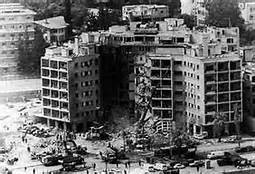
I led off with an illustration of a young Marine injured in the base bombing in October of 1983 in Beirut, Lebanon. It included reciting the corps’ motto – semper fi – always faithful.

bombing

Following the message, our lead worshipper, one of them more faithful men I’ve had the privilege of knowing, shared spontaneously prior to taking us into the final song. One of his sons is a Marine. Before long our country will deploy that young man to Afghanistan for a second time. Steve shared how he often gets asked how he deals with the anxiety related to his son’s service in harm’s way. He always says the same thing. “I believe God is sovereign. I could choose to be fearful. But because God is faithful, I choose to be faithful as well.”

You could feel the weight of the Spirit fall on our people. We beheld Him in His power and glory.

What’s the difference between living fearfully or faithfully? Steve got it right. It comes down to confidence in the sovereignty of God over all things and that He is never anything less than faithful. One of the best biblical examples I can cite for this comes from Acts 18:1-11.

After this Paul left Athens and went to Corinth. 2 And he found a Jew named Aquila, a native of Pontus, recently come from Italy with his wife Priscilla, because Claudius had commanded all the Jews to leave Rome. And he went to see them, 3 and because he was of the same trade he stayed with them and worked, for they were tentmakers by do-not-be-afraidtrade. 4 And he reasoned in the synagogue every Sabbath, and tried to persuade Jews and Greeks. 5 When Silas and Timothy arrived from Macedonia, Paul was occupied with the word, testifying to the Jews that the Christ was Jesus.6 And when they opposed and reviled him, he shook out his garments and said to them, “Your blood be on your own heads! I am innocent. From now on I will go to the Gentiles.” 7 And he left there and went to the house of a man named Titius Justus, a worshiper of God. His house was next door to the synagogue. 8 Crispus, the ruler of the synagogue, believed in the Lord, together with his entire household. And many of the Corinthians hearing Paul believed and were baptized. 9 And the Lord said to Paul one night in a vision, “Do not be afraid, but go on speaking and do not be silent, 10 for I am with you, and no one will attack you to harm you, for I have many in this city who are my people.” 11 And he stayed a year and six months, teaching the word of God among them.

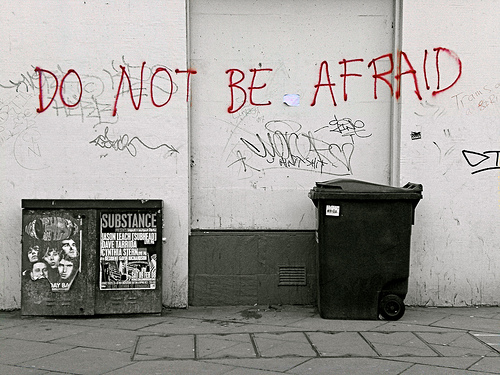
I love v. 9. “Do not be afraid,” the Lord tells Paul. I rarely think of the apostle Paul as experiencing fear issues, but apparently the circumstances in Corinth unnerved him. The Lord needed to administer a booster shot of courage. How did He do that? He assured Paul that in His sovereign plan He had yet many more elect who would come to Christ and nothing would prevent that from happening. That confidence put eighteen more months of fuel for service in Paul’s missionary tank.

What challenges do you face on the family front, the ministry front, the vocational front, on whatever front? You can choose to live fearful in the face of those things or you can choose to live faithful. It comes down to whom you think controls all things and whether or not you can trust the Lord’s great faithfulness. You bet your life you can. He is always faithful.

Fearful or Faithful?

faith fear

If I can help it, I rarely miss corporate worship on Sunday mornings. And not just because I pastor for a living. I’ve experienced more times than I can recount the reality of Psalm 63:2 – So I have looked upon you in the sanctuary, beholding your power and glory. God shows up stunningly more than not in the gatherings of His people for praise and community in ways He does not show up in private.

We experienced that this past Sunday at OGC. I preached a message called “The Tale of Two Trials” from John 18:12-27. You can listen to the audio here. John shows the flawless faithfulness of Jesus in the face of malice and betrayal. He remains faithful where the high priest proves malicious and Peter proves faithless. Rightly understood, the contrast in the text can take the breath away.

I led off with an illustration of a young Marine injured in the base bombing in October of 1983 in Beirut, Lebanon. It included reciting the corps’ motto – semper fi – always faithful.

bombing

Following the message, our lead worshipper, one of them more faithful men I’ve had the privilege of knowing, shared spontaneously prior to taking us into the final song. One of his sons is a Marine. Before long our country will deploy that young man to Afghanistan for a second time. Steve shared how he often gets asked how he deals with the anxiety related to his son’s service in harm’s way. He always says the same thing. “I believe God is sovereign. I could choose to be fearful. But because God is faithful, I choose to be faithful as well.”

You could feel the weight of the Spirit fall on our people. We beheld Him in His power and glory.

What’s the difference between living fearfully or faithfully? Steve got it right. It comes down to confidence in the sovereignty of God over all things and that He is never anything less than faithful. One of the best biblical examples I can cite for this comes from Acts 18:1-11.

After this Paul left Athens and went to Corinth. 2 And he found a Jew named Aquila, a native of Pontus, recently come from Italy with his wife Priscilla, because Claudius had commanded all the Jews to leave Rome. And he went to see them, 3 and because he was of the same trade he stayed with them and worked, for they were tentmakers by do-not-be-afraidtrade. 4 And he reasoned in the synagogue every Sabbath, and tried to persuade Jews and Greeks. 5 When Silas and Timothy arrived from Macedonia, Paul was occupied with the word, testifying to the Jews that the Christ was Jesus.6 And when they opposed and reviled him, he shook out his garments and said to them, “Your blood be on your own heads! I am innocent. From now on I will go to the Gentiles.” 7 And he left there and went to the house of a man named Titius Justus, a worshiper of God. His house was next door to the synagogue. 8 Crispus, the ruler of the synagogue, believed in the Lord, together with his entire household. And many of the Corinthians hearing Paul believed and were baptized. 9 And the Lord said to Paul one night in a vision, “Do not be afraid, but go on speaking and do not be silent, 10 for I am with you, and no one will attack you to harm you, for I have many in this city who are my people.” 11 And he stayed a year and six months, teaching the word of God among them.

I love v. 9. “Do not be afraid,” the Lord tells Paul. I rarely think of the apostle Paul as experiencing fear issues, but apparently the circumstances in Corinth unnerved him. The Lord needed to administer a booster shot of courage. How did He do that? He assured Paul that in His sovereign plan He had yet many more elect who would come to Christ and nothing would prevent that from happening. That confidence put eighteen more months of fuel for service in Paul’s missionary tank.

What challenges do you face on the family front, the ministry front, the vocational front, on whatever front? You can choose to live fearful in the face of those things or you can choose to live faithful. It comes down to whom you think controls all things and whether or not you can trust the Lord’s great faithfulness. You bet your life you can. He is always faithful.

Toughest School Ever (6)

No more posts on contentment.  With this I stop blogging on this virtue. The pain in the testing on the subject is more than I am willing to bear. Do I sound melodramatic?

I have always said, “Be careful what you preach on.” I have never preached a sermon series on spiritual warfare in part for fear of what hell Satan might unleash for my daring to mount an offensive so obviously aimed at his territory. Of course, if I live long enough to preach expositionally through the book of Ephesians, I will have no choice but to face the this-present-darkness music.

In my last post on the rare jewel of Christian contentment, I mentioned that part of what makes this particular school so tough is the mystery involved in it. Paul speaks in Philippians 4:12 of learning the secret of contentment. Furthermore I suggested that two reasons exist why genuine contentment in this life eludes some due to the mystery in it.

The second simply is this: genuine contentment relies on the strength of Another far superior to oneself for its existence. By far the most important verse in the treatise on contentment from Paul in Philippians 4 is v. 13. I can do all things through him who strengthens me.

As much as I admire Tim Tebow and his love for Jesus, his eye-black version of this verse has nothing to do with running for first downs in third-and-long situations or passing for touchdowns in the overtime of playoff games. It has everything to do with trusting Jesus for strength in both plenty and want, abundance and need.

Once again, Jeremiah Burroughs delivers:

THERE IS STILL A FURTHER MYSTERY, for I hope you will find this a very useful point and that before we have finished you will see how simple it is for one who is skilled in religion to get contentment, though it is hard for one who is carnal. I say, the eleventh mystery in contentment is this: A gracious heart has contentment by getting strength from Jesus Christ; he is able to bear his burden by getting strength from someone else. Now this is a riddle, and it would be counted ridiculous in the schools of the philosophers, to say, If there is a burden on you you must get strength form someone else. Indeed if you must have another come and stand under the burden, they could understand that; but that you should be strengthened by the strength of someone else, who is not near you as far as you can see, they would think ridiculous. But a Christian finds satisfaction in every circumstance by getting strength from another, by going out of himself to Jesus Christ, by his faith acting upon Christ, and bringing the strength of Jesus Christ into his own soul, he is thereby enabled to bear whatever God lays on him, by the strength that he finds from Jesus Christ. Of his fullness do we receive grace for grace; there is strength in Christ not only to sanctify and save us, but strength to support us under all our burdens and afflictions, and Christ expects that when we are under any burden, we should act our faith upon him to draw virtue and strength from him. Faith is the great grace that is to be acted under afflictions. It is true that other graces should be acted, but the grace of faith draws strength from Christ, in looking on him who has the fullness of all strength conveyed into the hearts of all believers.

Whether you find yourself in a season with sun shining down on you or walking in a desert place, I can tell you this: the secret of contentment and strength to endure lies in one Person and one person only.

Be strong in the Lord and the strength of His might (Ephesians 6:10).