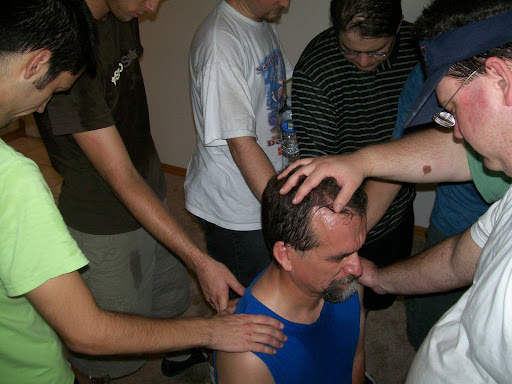
Praying & Armoring

Of all the “one another” passages in the New Testament constraining the manner of our engagement within the body of Christ, none has registered more relentlessly of late on my mind and heart than the one found in James 5:16.

Therefore confess your sins to one another and pray for one another, that you may be healed (emphasis mine).

The pray for one another segment of that passage has dominated my thinking and pastoral practice ever since reading this in The Deliberate Church by Mark Dever and Paul Alexander (Crossway, 2005, 221 pages):

One of the most practical things you can do for you own personal prayer life, and for the prayer lives of other church members, is to assemble a church membership directory . . . so that everyone in the church can be praying through it a page a day. . . . We usually encourage people to pray through the page number that corresponds to the current day of the month.

Capitol Hill Baptist Church, where these brothers minister, has a lot more folks attending than OGC does. I have discovered that we can pray through our entire flock every week without much difficulty. Teddie, our church office manager and executive assistant, prepared a special version of the directory for me that has the days of the week in the margin. Each day has about fourteen family units contained within. This breaks down the whole church into manageable portions. It makes it easy for me to pray for all our people at least once a week. No other tool of late more dramatically influences my praying.

On Sunday in our concert of prayer during the 9:30 hour I introduced this concept related to another important section of Scripture, namely Eph. 6:18. Paul concludes his treatment related to putting on the full armor of God with this exhortation:

Praying at all times in the Spirit, with all prayer and supplication. To that end keep alert with all perseverance, making supplication for all the saints.

I take that to mean that to some extent we cannot fully dress ourselves in spiritual armor without the aid of intercession by our fellow saints. This is a sobering conclusion! Who wants to go into battle without adequate protection?

So I reiterate my exhortation of Sunday morning to all of you who attended the concert of prayer and received a copy of the latest directory divided into days of the week. PRAY FOR ONE ANOTHER. Join me, the staff, and the leadership team as we press in with concerted, regular, faithful intercessory prayer that we might be strong in the Lord and the strength of His might (Eph. 6:10).

If you missed our prayer time last Sunday but would like a copy of the directory for prayer purposes, contact the office and we will be glad to see that you get a copy.

Sin, Addiction, & Biblical Arithmetic

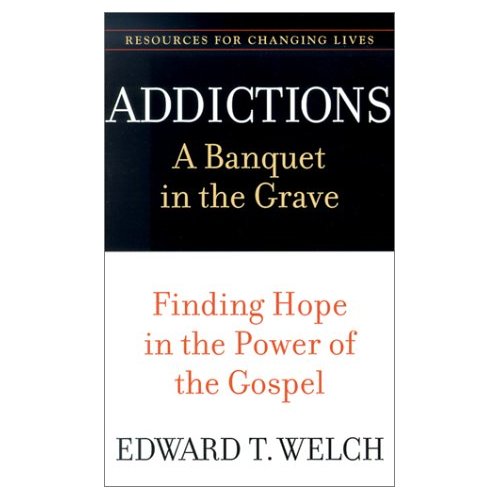
I continue to read through for the second time Ed Welch’s book, Addictions: A Banquet in the Grave. It is subtitled, Finding Hope in the Power of the Gospel.

He offers this helpful counsel about dealing with sin and its potential to enslave to bondage:

Remember that the diagnosis of sin is never the last word. Instead, the last word is Jesus Christ. Sin should take us right to Jesus. The way out of addictions is to talk more about Jesus, the Redeemer and Liberator, than about sin. . . . The biblical arithmetic is this: for every one look at your sin, take ten looks at Christ. Doctrine must not only be practical, it must also naturally point us to Jesus Christ.

Let us preach the gospel to ourselves everyday, from the moment our feet touch the floor in the morning to the point at which we slip back into our beds at night.

A Prayer Following Prayer

I got this from Tim Challies today.

It’s a Puritan prayer from the Valley of Vision.

O God of grace,
I bewail my cold, listless, heartless prayers;
their poverty adds sin to my sin.
If my hope were in them I should be undone,
But the worth of Jesus perfumes my feeble breathings, and wins their acceptance.
Deepen my contrition of heart,
Confirm my faith in the blood that washes from all sin.
May I walk lovingly with my great Redeemer.
Flood my soul with true repentance that my heart may be broken for sin and unto sin.
Let me be as slow to forgive myself as thou art ready to forgive me.
Gazing on the glories of thy grace may I be cast into the lowest depths of shame.
And walk with downcast head now thou art pacified towards me.
O my great High Priest,
pour down upon me streams of needful grace,
bless me in all my undertakings,
in every thought of my mind,
every word of my lips,
every step of my feet,
every deed of my hands.
Thou didst live to bless,
die to bless,
rise to bless,
ascend to bless,
take thy throne to bless,
and now thou dost reign to bless.
O give sincerity to my desires,
earnestness to my supplications,
fervour to my love.

Lessons from the School of Prayer

One last thought from Dr. Carson.

So far:

Much praying is not done because we don’t plan to pray.
Adopt practical ways to impede mental drift.
At various periods in your life, develop, if possible, a prayer-partner relationship.
Choose models, but choose them well.
Develop a system for your prayer lists.
Mingle praise, confession, and intercession; but when you intercede, try to tie as many requests as possible to Scripture.
If you are in any form of spiritual leadership, work at your public prayers.

Number 8:

Pray until you pray.

This is Puritan advice. Carson writes:

What they meant is that Christians should pray long enough and honestly enough, at a single session, to get past the feeling of formalism and unreality that attends not a little praying. we are especially prone to such feelings when we pray only for a few minutes, rushing to be done with a mere duty. To enter the spirit of prayer, we must stick to it for a while. If we “pray until we pray,” eventually we come to delight in God’s presence, to rest in his love, to cherish his will. Even in dark or agonized praying, we somehow know we are doing business with God. In short, we discover a little of what Jude means when he exhorts his readers to “pray in the Holy Spirit” (Jude 20)–which presumably means it is treacherously possible to pray not in the Spirit.

He ends with this:

In the Western world we urgently need this advice, for many of us in our praying are like nasty little boys who ring front door bells and run away before anyone answers. Pray until you pray.

Lord, let us linger.

Pray for India this Month

Global Prayer Digest focuses this month on the Indian subcontinent.

In this month’s details they post a fascinating article on the Ganges River and its significance to the peoples of India. Here is a sample from that page.

In many religious traditions, there is a special river that symbolically washes away impurities and sins. In ancient Persia, there was the Tigris and the Euphrates, and in Egypt, it was the Nile. When it comes to the Ganges River, Hindus probably outdo them all. Some believe that life is incomplete without taking a holy dip, or bath, in the Ganges. One Hindu pilgrim told a BBC News reporter that, “I am here to wash away my sins-the sins I accumulated in my life so that I can die as a pious soul.” (Jan. 15, 2007, BBC News). Many Hindu families keep a vial of Ganges water in their homes. This gives the family prestige. If anyone is dying in the home, they can drink from this vial of water. They believe that act will either cure them or cleanse their souls of all past sins. Sadly, the water is so badly polluted that it most likely speeds their death.

Will you join me in praying this month for spiritual breakthroughs for the glory of God and the fame of the Name in India?

The Lord Will Make You a House

A bunch of us moved our reformed Canuck friend, Norm, into his new condo this morning. The best thing about being over fifty and nursing a stiff back is that you get to take pictures while everyone else lifts stuff. A great group of guys got ‘er done in only three hours. Why guys choose to move in August in Florida, I’ll never know, but the man has his own place now. God is good. All the time.

After all the heavy lifting was over, I led us in a brief dedication of the place. I read from 2 Samuel 7. David thought he would build God a house, but God said, no. Rather He declared through the prophet that He would make him a house (v. 11). We call that the Davidic covenant. What a house!

It lead David to pray this way in v. 18. Who am I, O Lord God, and what is my house, that you have brought me thus far? And then in v. 29, Now therefore may it may it please you to bless the house of your servant. We all lay hands on Normand asking God to bless the man and his new digs. It could be said of all us, who are we that He has brought us thus far, and oh how desperately we all need His blessing on our houses.

Lessons from the School of Prayer

Class on Saturday, PC?

You bet. This school on this subject never closes.

So far we have these principles:

Much praying is not done because we don’t plan to pray.
Adopt practical ways to impede mental drift.
At various periods in your life, develop, if possible, a prayer-partner relationship.
Choose models, but choose them well.
Develop a system for your prayer lists.
Mingle praise, confession, and intercession; but when you intercede, try to tie as many requests as possible to Scripture.

Now for number seven:

If you are in any form of spiritual leadership, work at your public prayers.

D. A. Carson exhorts:

Many facets of Christian discipleship, not least prayer, are rather more effectively passed on by modeling than by formal teaching. Good praying is more easily caught than taught. If it is right to say that we should choose models from whom we can learn, then the obverse truth is that we ourselves become responsible to become models for others. So whether you are leading a service or family prayers, whether you are praying in a small-group Bible study or at a convention, work at your public prayers.

Enough said. Time to work on my pastoral prayer for tomorrow.