More Puritan Power for the LB

William Gurnall writes:

Wickedness must be weak. The devil’s guilt tells them their cause is lost before the battle is ever fought. They fear you, Christian, because you are holy; so you do not need to fear them at all. When you see them as subtle, mighty, and many, your heart beats fast. But look on all these spirits as ungodly wretches who hate God more than they hate you. And the only reason they detest you at all is your kinship to Him. Whose side is God on? In the past He rebuked kings for touching His anointed ones. Will He stand still now and let those wicked spirits threaten his life in you without coming to your rescue? It is impossible.

Faith & Food (Part 7)

Here is the John MacArthur quote about Jesus’ meaning in saying we must eat of Him as the bread of life that I shared from this morning’s message in John 6:52-59.

Now, when we think about this analogy, it should just conjure up in your mind all kinds of appropriate relationships to the spiritual apprehension of Christ. Let me see if I can’t help you with that. Eating, just take eating in general. If we’re talking about the physical bread and the physical eating. First of all, eating is a necessary act if I am to derive any advantage from the bread. Is that not true? Now I like bread. I like bread a lot. I grew up with a mother and a grandmother that made bread all the time, still do. Rarely do I ever visit my mother when she, knowing I’m coming, doesn’t have bread made for me. I love bread. My wife makes bread. We have a bread maker. I like to walk in the house and smell it. I like to see it. I like the color of it. Sometimes I like just to squeeze it. And I can go on and on about the – I can eulogize the crust. I can get into this stuff. I like all kinds of bread with all kinds of different things in it. But I may look at that bread, and I may admire that bread, and I may sniff that bread, and I may analyze that bread, and I may philosophize about that bread, and I may eulogize its qualities, and I may touch it and handle it, and I may be assured of its excellencies. And I might even trust the baker. But if I don’t eat it, it doesn’t nourish me. How obvious is that.

You may access his entire sermon here.

The Gun Cabinet & Re-Creation

Finally, we found one. We searched a long time. Every time we’ve come to Idaho the last several years we’ve visited the thrift and second-hand stores looking for a good bargain on a used gun cabinet. It simply will not do for a Nimrod-wanna-be (see Gen 10:8-9) to store his rifles in a closet!

Not until this trip however did Nancy and I enjoy success. B&B in Grangeville had an old, beat up, paint-splattered, locked-with-no-keys-available, six-slotted deal with a glass front sporting some nifty etching of ducks and cattails. And the man only wanted $35 for it!

After talking him down to $30 (I have no shame, but that’s what those kind of places are for, if you ask me), we loaded up and took the thing back to our place. No one surpasses my bride in taking used stuff and making it shine like new. Out came the Old English furniture scratch repair polish. We covered over every imperfection from top to bottom. The polish acted like a solvent so we were able to scrape off all the paint speckles. Windex sprayed within and without put sparkle on the glass. We vacuumed out the inside. Voila. Good as new. Ready for guns in the spot in the living room I imagined for it all these years. Sweet. Good things come to those who wait.

But who’s kidding whom? While the thing looks great thanks to Nancy’s extreme makeover magic, it isn’t new, not by a long shot. It’s still basically the same old used, pressed wood, cheap man’s gun cabinet. All we did was make some repairs and mask the imperfections the best we could. More than suitable for a mountain home in Idaho, but certainly not just-out-of-the-carton-brand-spanking-new by any means.
How entirely different is the case for anyone known to be “in Christ.” The apostle Paul declares in 2 Cor. 5:17, “Therefore, if anyone is in Christ, he is a new creation. The old has passed away; behold, the new has come.” When God gets a hold of someone by His amazing grace, He doesn’t just make some repairs and mask imperfections in us; He makes us entirely new! At the moment of faith where one becomes organically linked to Jesus, we say good-bye to the old us and hello to a brand new version. Our God, Rev. 21:5 says, specializes in making all things new. That’s His deal. That’s what ultimately matters when it comes to our relationship with Him (Gal. 6:15).

The Baker New Testament commentary on 2 Corinthians says this about 5:17 – “When people become part of the body of Christ at conversion, their lives take a complete reversal. They now abhor the world of sin and former friends are hostile to them. Their preconversion lifestyle is history.”

Old gun cabinets may enjoy a transformation of sorts by external treatment and concentrated repair. But they remain old gun cabinets just the same. But behold! Believers in Christ enjoy a transformation of another sort that leaves them fundamentally and completely changed – so much so that we may rightly refer to ourselves as new, gloriously and wonderfully new in Him.

Things We Do Before the Lord

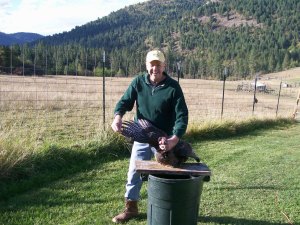
It didn’t take long. Within half a day of touching down on Idaho soil, shot gun in hand, I headed out to hunt on the final day of turkey season. As you can see, the Lord went with me. He gave me good success. I bagged a hen from last year’s hatchlings.

An obscure verse of Scripture from the genealogy in Genesis 10 came to mind somewhere along the way. Verse 8 says, “Cush fathered Nimrod; he was the first on earth to be a mighty man.” What a way to go down in the biblical record!

How did he demonstrate his strength? Verse 9a gives the answer – “He was a mighty hunter before the LORD.” It was true to so great an extent that the rest of the verse indicates that the ancients coined a proverb in light of Nimrod’s prowess in the field. “Therefore it is said, ‘Like Nimrod a mighty hunter before the LORD.’”

I suspect Nimrod gained his reputation for hunting game bigger and badder than turkeys. Never fear. Whitetail deer and elk season in these parts opened the next day. The thing that ultimately arrested my attention however was the fact that he hunted BEFORE THE LORD. All that traipsing around the woods with a weapon occurred before the eyes of a watching God. Hunting? Yes, hunting.

What else goes on before the Lord, I wondered? Even a brief survey of the Bible reveals a lot of specifics that go on before the eyes of the omniscient One.

For example – Being silent (Zech. 2:13). Fasting (Jer. 36:9). Trembling (Psalm 96:9). Walking (Psalm 116:9). Being guilty (2 Chron. 19:10). Praying (Dan. 9:20). Sacrificing (2 Chron. 7:4). Humbling self (2 Kings 22:19). Doing evil (2 Kings 21:2). Hanging (2 Sam. 21:6). Worshiping/dancing (2 Sam. 6:5, 14). Being detained (1 Sam. 21:7). Ministering (1 Sam. 3:1). Growing up (1 Sam. 2:21). Sinning (1 Sam. 2:17). Weeping (Judges 20:23). Eating (Deut. 12:7). Feasting (Ex. 32:5). Bringing a case (Num. 27:5). Even dying (Lev. 10:2).

Proverbs 5:21 makes the obvious point of this word search exercise. “For a man’s ways are before the eyes of the LORD, and he ponders all his paths.”

From hunting to worshipping to living and dying, we do it all before the eyes of God in heaven. He takes it all in. And He ponders our paths. The Hebrew word means to weigh something – to judge it. The One who bring all things to judgment on the last day, weighs our every action as it unfolds before His eyes.

This sobering truth should lead to some pondering of our own. Proverbs 4:26 exhorts us – “Ponder the path of your feet; then all your ways will be sure.”

Whether your feet take you into the forest to hunt, into the sanctuary to worship, into the dining room to feast, or, God forbid, onto the gallows to hang, and finally even onto your deathbed to die, remember this – every last bit of it, all of it is before the Lord.

Time to Vacate

It’s that time of year again. The Pacific Northwest beckons. Today we fly to Clearwater, Idaho for two weeks of R&R. Turkey season closes tomorrow. That’s the bad news. Whitetail deer season opens tomorrow. That’s the good news. Fishing season never closes. More good news.

All of that to say that my bride and I are headed for the wilderness, pictured above, to refuel the engines and kill and catch some stuff. We ARE remote and have little access to the web, so I do not know how much, if at all, I will post during these two weeks.

Lord willing, we will return on October 23 and I will resume preaching on the 25th with more from John’s Gospel and the bread of life discourse.

Please pray for refreshment from the Lord in both spirit and body!

OGC Men’s Retreat – October 30-31

We are pleased to have Pastor Jack Jenkins, pictured here with his wife Gayle, of Faith Baptist Church, Orlando, as our keynote speaker for this year’s men’s retreat on October 30 and 31 at Camp Ithiel.

The theme of this year’s retreat is:

Trusting the Sovereignty of God in Adversity:
A Study from the Life of Joseph

Here are the four session titles for the weekend:

Session #1: God’s sovereignty can be trusted when we do what’s right and everything seems to go wrong!

Session #2: God’s sovereignty works to our advantage, especially in adversity.

Session #3: God’s sovereignty gives us divine reasons for granting forgiveness to others.

Session #4: If God is sovereign, then what’s my responsibility?

Be sure to stop by the registration table this Sunday or next and reserve your spot! The cost is $75 per man, $40 per student. Some scholarship assistance is available upon request.

Twelve Propositions About Sanctification

These are from J. C. Ryle in his book Holiness.

He cites these propositions after defining sanctification as that inward work which the Lord Jesus Christ works in a man by the Holy Ghost, when He calls him to be a true believer. He not only washes him from his sins in His own blood, but He also separates him from his natural love of sin and the world, puts a new principle in his heart, and makes him practically godly in life.

  1. Sanctification is the invariable result of that vital union with Christ which true faith gives to a Christian.
  2. Sanctification is the outcome and inseparable consequence of regeneration.
  3. Sanctification is the only certain evidence of that indwelling of the Holy Spirit which is essential to salvation.
  4. Sanctification is the only sure mark of God’s election.
  5. Sanctification is a thing that will always be seen.
  6. Sanctification is a thing for which every believer is responsible.
  7. Sanctification is a thing which admits of growth and degrees.
  8. Sanctification is a thing which depends greatly on a diligent use of means.
  9. Sanctification is a thing which does not prevent a man having a great deal of inward spiritual conflict.
  10. Sanctification is a thing which cannot justify a man, and yet it pleases God.
  11. Sanctification is a thing which will be found absolutely necessary as a witness to our character in the great day of judgment.
  12. Sanctification is absolutely necessary, in order to train and prepare us for heaven.

He quotes the Puritan John Owen regarding this last proposition:

There is no imagination wherewith man is besotted, more foolish,none so pernicious, as this–that persons not purified, not sanctified, not made holy in their life, should afterwards be taken into that state of blessedness which consists in the enjoyment of God. Neither can such persons enjoy God, nor would God be a reward to them. . . . Holiness indeed is perfected in heaven: but the beginning of it is invariably confined to this world.

Saint of God, give yourself today to the means of grace that help conform you to the Son of God to the glory of God to prepare you for the dwelling place of God.

Bless You Cancer (19)

It has been some time since I have revisited this stream of posts. Today I reviewed several entries from my journal of 2005 covering the end of September into the beginning of October. This comes from 09.24.05, thirty-four days after finishing treatment for my head and neck cancer (note – I was still virtually completely unable to eat any solid food):

The Lord knew I would feel discouraged yesterday. He sent me multiple encouragements by email and visitor. Fred P’s (a fellow head and neck survivor from Philadelphia I encountered through my network of friends and fellow-believers) gave me perspective through his doctor of all sources. I’m about where I’m supposed to be. My kind of cancer has among the harshest treatments in terms of impact on the body. That doctor tells people to expect a full year to recover normalcy. That was both good news and bad news to me. Clearly I have to adjust my expectations at how quickly my mouth will heal (I was under the faulty impression improvement would begin immediately). It is just going to take time. The whole R family came by for the night. We had a lovely visit. They lifted my spirits. Jeannie S sent me a nice letter too. God comforts the depressed by sending a Titus or two (2 Cor. 7:6). Praise His name.

Do you know a downcast saint you could comfort by a note, email, or visit today or sometime soon? Don’t underestimate the significance to him or her of even the slightest encouragement on your part. God’s comfort may well come through you at just the most needful time.

Responsibility & Inability

I made the point in the sermon from John 6:41-51 that Jesus requires us to repent and believe (v. 47). But it is also true (obnoxiously so according to Spurgeon) that we cannot do it (v. 44) left to our own devices. What are we to make of this conundrum between our responsibility to come and our inability to do so? Shouldn’t we be responsible only for what we are able to do and not what we are unable to do?

Wayne Grudem offers this in reply in his one volume systematic theology:

The idea that we are responsible before God only for what we are able to do is contrary to the testimony of Scripture, which affirms both that we “were dead through the trespasses and sins” in which we once walked (Eph. 2:1), and thus unable to do any spiritual good, and also that we are all guilty before God. Moreover, if our responsibility before God were limited by our ability, then extremely hardened sinners, who are in great bondage to sin, could be less guilty before God than mature Christians who were striving daily to obey him. And Satan himself, who is eternally able to do only evil, would have no guilt at all—surely an incorrect conclusion. The true measure of our responsibility and guilt is not our own ability to obey God, but rather the absolute perfection of God’s moral law and his own holiness (which is reflected in that law).

Grudem, W. A. (1994). Systematic Theology : An introduction to Biblical Doctrine (499). Leicester, England; Grand Rapids, Mich.: Inter-Varsity Press; Zondervan Pub. House.